
Relations
A field can point at another model. You declare it once, and crud add turns it
into a dropdown populated from the related model’s rows — no hand-wiring. It’s
modeled after Symfony’s make:entity relation flow.
Declare the relation
Use ref(Model) as the field type. The related model must already exist.
# the model you'll point atvsceasy model add --name category --fields "id:string!,name:string"
# the field that references itvsceasy model add --name todo \  --fields "id:string!,title:string,category:ref(Category)"
In the interactive loop the prompt lists the models you can relate to, and an
invalid ref(X) errors with the model to create first.
What the model stores
category:ref(Category) becomes a categoryId foreign key plus a metadata block:
export interface Todo {  id: string;  title: string;  categoryId: string;  // → Category}
export const TodoRelations = {  categoryId: { model: 'Category' },} as const;
The FK stores the related row’s id. TodoRelations is what crud add reads to
build the dropdown — you don’t touch it by hand.
The dropdown label defaults to the related model’s first string field. Override
it with label=<field>:
--fields "...,category:ref(Category, label=name)"What CRUD generates
Run crud add on the model with the relation:
vsceasy crud add --model todo --menu new:todosThree things get wired automatically:
-
The form API gains
options():src/shared/api.ts export interface TodoFormApi {// …options(): Promise<Record<string, { value: string; label: string }[]>>;} -
The form panel implements it — loading the related rows over the repo:
src/panels/todoForm.ts import { CategoriesRepo } from '../models/Category';// …async options() {return {categoryId: (await CategoriesRepo().findMany()).map((x) => ({ value: String(x.id), label: String(x.name) })),};} -
The form webview renders a populated
<select>— loading options on mount and storing the chosen id:src/webview/panels/todoForm/App.tsx const [relOptions, setRelOptions] = useState({});useEffect(() => { void api.options().then(setRelOptions); }, []);// …<select value={form.categoryId ?? ''} onChange={…}><option value="" />{(relOptions['categoryId'] ?? []).map((o) => (<option key={o.value} value={o.value}>{o.label}</option>))}</select>
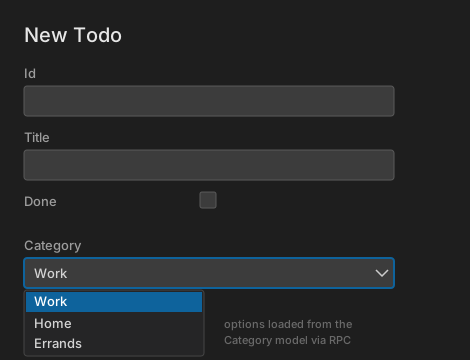
The result — the Category field is a dropdown of the actual Category rows:
Scope
Relations are ManyToOne: a foreign key on one model pointing at another. The
FK holds the related id — there’s no join table, cascade, or eager join. To show
a related label in the list (not just the form), join in your service’s
list() method, or store a denormalized label.